In April 2022, I visited the archaeological site of Ganweriwala – a city of the Indus Valley Civilisation located in the Cholistan Desert, in southern Punjab. The following account is based on observations made during the trip, interviews and the study of archaeological reports.
At dawn, the clinking of cowbells can be heard in the streets of Basti Parhyar, a village that lies in the shadow of Derawar Fort, in Punjab’s Cholistan Desert. Zebu cattle stroll through the streets, making their way home after a night spent grazing in the vast expanse that surrounds the settlement. They often go as far as five miles from the village, accompanied by three or four shepherds who spend the night tending to the cattle and cooking themselves dinner in the desert.
Shahwal Parhyar, a lifelong resident of Basti Parhyar, is the eldest woman in a house of 14 people, most of whom are women and children. In the months of May, June, July and August, when rain is expected, her entire family leaves their home and moves into huts of straw and wood, nine miles away, near a watering hole referred to as ‘Kutanya wala tobha’, so that their cattle has constant access to pasture. While encamped in the middle of the desert, Shahwal and the other women in her family make lassi – a local drink made of yoghurt and water – embroidered blankets referred to as rilhees and clothes for themselves.
Shahwal recalls the story she heard from her parents, of a war that led to widespread devastation. The tale revolves around the perennial Hakra River, which once flowed through these parts. “First there was a war, then someone broke the bund [embankment]”, she says, adding that the Hakra was in high flood at the time.
Like most residents of Cholistan, Shahwal knows her way around the desert. She is familiar with the mounds she refers to as “Ganweriwala”, where an ancient city lies buried. The veteran archaeologist Rafique Mughal discovered the site while conducting a three-hundred-mile survey of the dry Hakra River bed between 1974 and 1977, according to his report, Recent Archaeological Research in the Cholistan Desert (1979). When I contacted Mughal, he told me that the city was synchronous with Mohenjo-daro and Harappa and third in line when it came to size.
Ganweriwala lies roughly twenty-two miles south-west of Basti Parhyar, in Rahim Yar Khan District, an hour-and-a-half’s drive on a dirt track. I learn of its whereabouts from the Deputy Director of Archaeology in Punjab, Muhammad Hassan, who also advised me on how to get there. Mushtaq Ahmed, a local guide who lives in Basti Parhyar, agrees to take me.
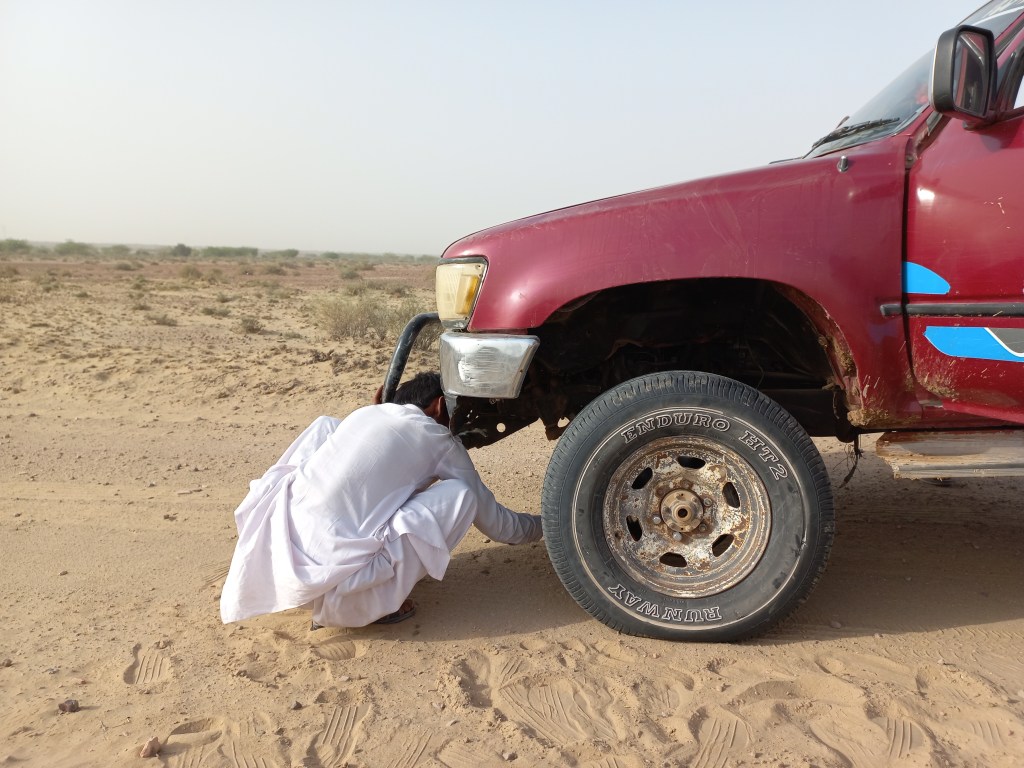
We set out at dawn, in a rickety Datsun double-cabin that is on its last legs. It is one of many taxis that operate out of the desert, transporting locals and livestock to remote spots that lack metalled roads. The old vehicle risks breaking down – which it eventually does – miles away from any human habitation or mobile network coverage. But such concerns are met with a polite laugh by the locals and dismissed as paranoia.
During the journey, Ahmed points to a couple of abandoned huts, recalling Shahwal’s story of the four-month migration to the desert during the monsoon.
The flat landscape is dotted with begonia (lana) and calligonum (phog) shrubs and the odd tamarix and mesquite tree. Dunes are few and low-lying, some taking the shape of long bunds. After a while, the trees disappear. As the day heats up, spiny-tailed lizards dart across the desert floor.

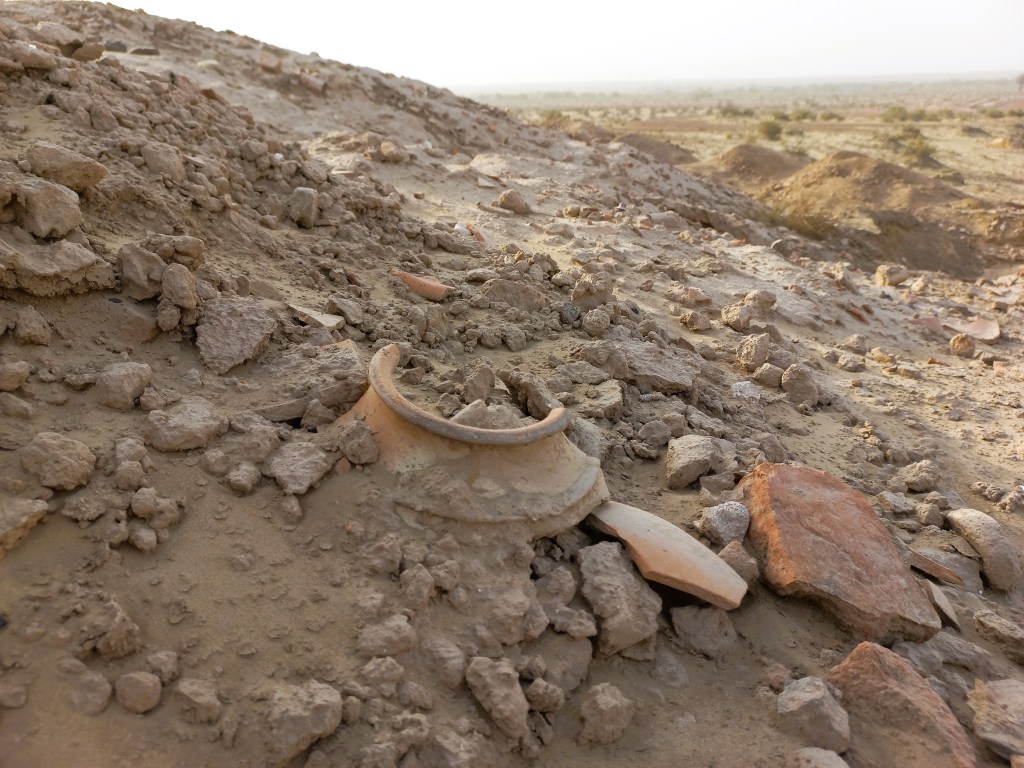
The ruins lie at a slight elevation, on two sprawling mounds. The site is covered by a rubble of red and black pebble-sized fragments of bricks. Some of the shards of pottery found at the surface are large and partially submerged. There is evidence of digging by treasure hunters and ancient skulls of animals can be seen in some places.
The dirt road goes over both mounds, partially cutting through their uppermost portions. The road was not there when Mughal surveyed the site in the 1970s, but when he visited next, 2011, it had already been laid out. When the archaeologist Farzand Masih surveyed the site in 2007, he noted in his report, Ganweriwala – A New Perspective, that the four metre wide road had been built “in recent years… to facilitate the movement of hunting parties from the UAE”. Mughal tells me that the Emiratis visit every winter to hunt houbara bustard and chinkara deer. “They have built a palace near Rahim Yar Khan”, he says, referring to Sheikh Zayed Palace, located on the outskirts of the city.
According to the officials of the Houbara International Foundation and employees of the Cholistan Institute of Desert Studies, the Emiratis acquire hunting permits from the Ministry of Foreign Affairs.

Shortly after our arrival at the ruins, we see an SUV approaching from a distance. A man wearing track-pants, a t-shirt and sunglasses, emerges from the vehicle. He had seen the dust kicked up by the double-cabin and decided to check up on us. He tells us that he has in the past caught treasure hunters at the site and escorted them to the local police station.
Mughal believes that the layout of Ganweriwala would have been no different to that of most Indus cities – including Mohenjo-daro and Harappa – comprising an elevated citadel and a residential area in the lower town. According to him, the Hakra River, known as the Ghaggar in India, flowed near Ganweriwala in the third millennium BC. As a result, the topography of the area back then would have been similar to that of the alluvial plain of southern Punjab, while the desert would have begun roughly twelve miles east of the site.
Masih’s team of surveyors had found at Ganweriwala a clay tablet depicting a human figure, with a devotee kneeling before it. In his report, Masih writes that the figure is seated in a “Baddha Konasana yogic position”. The other side of the tablet contained symbols of the Indus script. Abdul Jabbar, a field guide at Harappa, who was present at Ganweriwala when the tablet was found, tells me it is currently in storage in Lahore and not on display for the public.
Nukhbah Taj Langah, an academic and activist who has a PhD in Siraiki poetry and whose work focuses on Siraiki culture and language, laments the state’s disinterest in preserving Pakistan’s pre-Islamic heritage. “Siraiki is a very old language and belongs to a cultural heritage associated with the Indus Valley Civilisation”, Langah tells me. “In Cholistan, this huge desert area, local people are being side-lined, as a lot of people have become stakeholders in this region”, she says, adding, “Land is being purchased from local people at petty costs”.
“As a form of investment, people are establishing themselves in Cholistan, and in fact the local Cholistani people are being treated as marginalised, or they have been othered in their own homeland”, says Langah.
Siraiki activists like Langah spend a lot of time exploring the region and providing relief to locals in the wake of floods and famine. She points out that Cholistan is a goldmine of antiquities. “These antiquities are being dug out by people who do not belong to Cholistan and they are being either sold or taken away”, she says.
 Ali Bhutto